DolphinRadar at a glance
What is DolphinRadar?
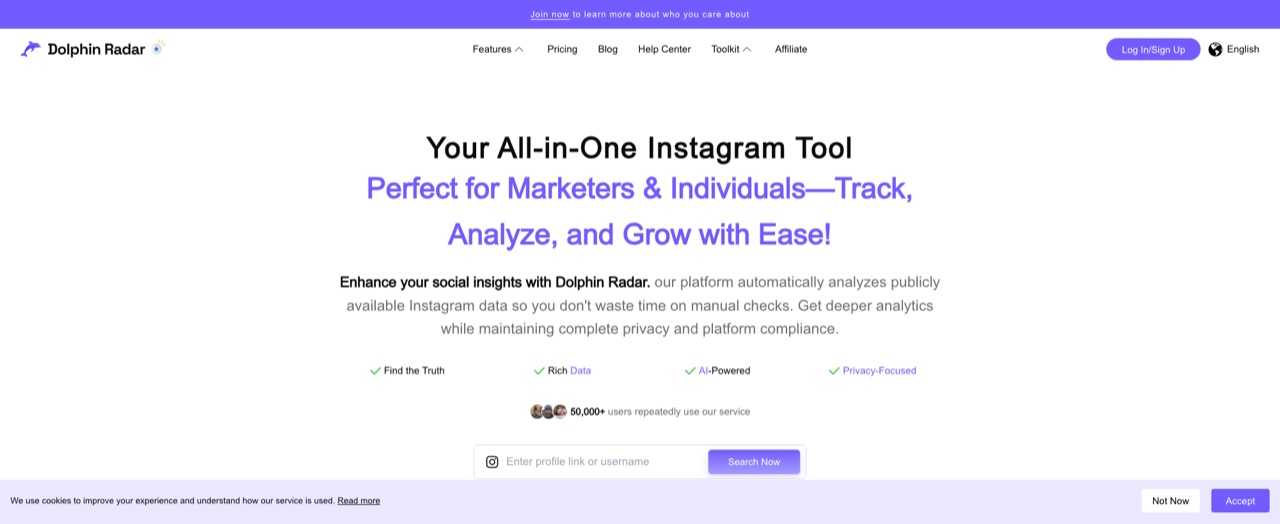
DolphinRadar is a third-party Instagram tracker that reads a public profile's visible activity and presents it as dashboards and reports. Its site claims "50,000+ users" and states it runs "entirely through a web browser with zero access to your account." You enter a username, pick a plan, and it monitors that account's follows, likes, and posting patterns.
The pitch is convenience: Instagram's own analytics only cover your account, so a tool that watches other public profiles fills a gap for competitor research. That framing is accurate as far as it goes. DolphinRadar reads only public data, which is legal to view, and it never touches your account. Two facts shape the rest of this review. It is a monitoring tool, not a story viewer, and because it reads public data it inherits a hard limit no subscription can remove.
Does DolphinRadar actually work?
Partly. For public accounts it does track follows, likes, and activity, but reviewers report it lagging and getting things wrong. As of 2026 its Trustpilot score sits around 2 out of 5 on a low review count, with users describing slow updates and inaccurate data (Trustpilot, 2026).
Two limits matter most, and DolphinRadar admits both. Its own tracker page concedes that "no third-party tool can access a private Instagram account's data, and DolphinRadar is no exception," the same server-side wall we cover in our guide to why private-viewer promises are always fake. The second limit is timing: it only collects data from your subscription start, with no historical backfill. You are buying a camera that starts recording the day you pay.
How we assessed DolphinRadar
DolphinRadar is a paid subscription tool rather than a one-click site, so this review is based on its own documentation, its public plan pages, and third-party trust databases, not a live network capture. Here is how it lands on the checks that decide the score.
How DolphinRadar scored 62/100
How DolphinRadar earned its 62/100 across nine weighted criteria. See the full scoring model →
What Trustpilot and ScamAdviser say about DolphinRadar
Separately from our own assessment, we cross-reference public review and domain-reputation databases. These signals inform context but do not feed our 62/100 score. Cross-referenced Jul 7, 2026.
Is DolphinRadar safe?
What DolphinRadar does, and does not, do. It earns real credit on credentials and loses ground on transparency and consent.
Green flags
- No Instagram login or password required
- Nothing to install; runs in the browser
- Reads only public data; never acts on your account
- Accurately admits it cannot see private accounts
- Sends no notification to the tracked account
Watch items
- Owner identity hidden in WHOIS records
- Trustpilot around 2/5 with mainly negative reviews
- Over-promises AI features it delivers inconsistently
- AI insights profile a person's relationships, psychology, location, and finances
- Data collected only from signup date; no history
- Refund and cancellation friction reported
On the metric that matters most, DolphinRadar passes: it never asks for your Instagram password. In 2019, Microsoft found that enabling multi-factor authentication blocks 99.9% of automated account-takeover attempts (Microsoft, 2019), and the surest way to protect a password is to never hand it to a third party. DolphinRadar does not collect one, which is exactly what we tell readers to demand.
That said, "no password" is not the same as "no risk." As of 2026, ScamAdviser rates the domain "very likely not a scam" but lists real negatives: the owner hides their identity in WHOIS records, the registrar carries a high share of spam and fraud sites, and the site "has received mainly negative reviews" (ScamAdviser, 2026). You also have to create an account, so the usual caveat applies: use a throwaway email, expect marketing mail, and never reuse a password. For the full rule set, see our 7-point viewer safety checklist and our guide on why you never hand a tool your Instagram login.
How does DolphinRadar work?
It runs in a browser, with no app and no access to your account, and only reads public data.
- Enter the username of a public Instagram account you want to track.
- DolphinRadar reads that account's public follows, likes, and posting activity from its subscription start onward.
- It presents the data as dashboards, and on the annual plan adds AI "insight" reports about the person.
Is DolphinRadar an ethical way to track someone?
This is where an honest review has to go further than the marketing reviews do. DolphinRadar's headline feature on its annual plan is a set of up to nine AI "insights" that profile a target person: relationship analysis, psychological and personality analysis, interests, financial status, and location or "encounter" mapping built from their captions and geotags. Sold as "competitor analytics," that reads a lot more like surveillance of an individual.
Why does that matter for safety? Because the demand it serves is often not marketing. In 2023, Norton found that 34% of people in a relationship admitted to checking on a current or former partner online without consent, rising to 60% among US adults aged 18 to 39 (Norton, 2023). Kaspersky's global survey found 23% had experienced online stalking from someone they were dating (Kaspersky, 2024). A tool that turns a stranger's public posts into a psychological and location profile lands squarely in that space.
To be precise: DolphinRadar is not stalkerware. Stalkerware is covert software installed on a victim's own phone, and Kaspersky recorded more than 31,000 people affected by it in 2023 alone (Kaspersky Securelist, 2024). DolphinRadar installs nothing and reads only public data. But the profiling intent is adjacent, and the wider context is a data economy the FTC has called "vast surveillance" (FTC, 2024). Our position: analyzing a public competitor account for a campaign is fair game; building a psychological or location dossier on an individual who has not consented is not, whatever the dashboard calls it.
DolphinRadar pros and cons
Pros
- No Instagram login or password required
- Nothing to install; runs in the browser
- Reads only public data; does not touch your account
- Cheaper than rivals at $32.99/yr
- No notification to the tracked account
Cons
- Trustpilot around 2/5; mainly negative reviews
- Owner identity hidden in WHOIS records
- Cannot access private accounts; only tracks from signup
- Profiling "AI insights" invite misuse against a person
- Refund and cancellation friction reported
How much does DolphinRadar cost?
DolphinRadar is subscription-only with no useful free tier, and it runs cheaper than the affiliate reviews suggest. The "$29 to $199" figures floating around are old or simply wrong.
| Plan | Price | Effective monthly | Notes |
|---|---|---|---|
| Monthly | $4.49/mo | $4.49 | Basic tracking; AI insights locked |
| Quarterly | ~$10.99/qtr | ~$3.66 | Same basics, small discount |
| Annual | $32.99/yr | ~$2.75 | Unlocks the 9 AI insight modules |
The cheap monthly plan buys one tracked account, weekly reports, and recent followers, with the marquee AI insights reserved for the annual commitment. Reviewers flag refund friction and a subscription that is hard to cancel, so treat any longer plan as a real commitment, not a casual trial.
What are the best DolphinRadar alternatives?
The safest alternative for most people is a native tool or none at all. For your own account, Instagram Insights is free, accurate, and consent-clean. For competitor research, established analytics platforms do the job without personal profiling. And if all you actually need is anonymous viewing of public stories rather than tracking, the top-scored viewer on our index is PeekViewer (86/100, Safe).
What we will not recommend is the "private account viewer" category some DolphinRadar reviews push as the upgrade. Those promise what DolphinRadar honestly admits is impossible, and the promise is the setup for a scam, as we detail in how to identify an unsafe Instagram viewer. If your goal is anonymous story viewing rather than tracking, compare tested options in our viewer rankings and read whether anonymous viewers are safe at all.
The verdict: is DolphinRadar worth it?
For a narrow, ethical use case, DolphinRadar is a defensible low-risk tool; for anything involving an individual, it is hard to endorse. It earns real credit for never touching your login, and for a marketer benchmarking public competitor accounts at $32.99 a year, it is a cheap, no-credential option, if you can tolerate lag and inaccuracy.
But the trust signals are weak, the vendor hides behind WHOIS privacy, and the features that justify the annual price are built to profile people. Weigh it against the rule that guides every review we publish: a tool is only as safe as the way you use it. Track your own competitors, not a person who has not agreed to be watched, and never let a low price talk you into a longer plan you cannot easily cancel.
DolphinRadar FAQ
As of 2026, DolphinRadar costs $4.49 per month or $32.99 per year, with a quarterly tier around $10.99. The AI insight modules unlock only on the annual plan. There is no meaningful free version, and reviewers report that cancellations and refunds can be difficult.
Yes on both counts. DolphinRadar states the tracked account receives zero notifications and your identity never appears in their follower list. Because you never log in, your own account stays out of it. That anonymity is also why the consent question matters so much.
It is safer than login-based tools because it never collects your Instagram password, and enabling MFA blocks 99.9% of account-takeover attempts anyway (Microsoft, 2019). The risks here are different: a hidden owner, sign-up spam, and refund friction. Use a throwaway email and a unique password.
No. DolphinRadar itself admits that no third-party tool can access a private Instagram account's data. Private posts are served only to approved followers, and Meta shut down the last third-party route to personal data on December 4, 2024.
It is technically legit: a real service that tracks public activity, and ScamAdviser rates it very likely not a scam. But legit is not the same as good. With a roughly 2 out of 5 Trustpilot score, a hidden owner, and features it delivers inconsistently, it sits in the gray zone between working tool and overpromise.
Review integrity
How this review is produced and kept honest.